
Cat Swallowed a Foreign Object: What to Do
If your cat swallowed a foreign object, this is a situation that requires immediate veterinary attention. Cats are curious, playful animals, and they occasionally ingest things they should not. A swallowed foreign object can cause serious complications including internal blockages, perforations, and life-threatening gastrointestinal emergencies. In this blog, we’ll explore what every cat owner should know about this common, dangerous situation.
What Objects Do Cats Commonly Swallow?
Cats tend to be attracted to small, lightweight, and often string-like objects. Understanding what puts your cat at risk is the first step toward prevention. Common foreign objects that cats swallow include string, ribbon, rubber bands, hair ties, small toy parts, pieces of plastic, needles and thread, bones, and paper.
String-type items are among the most dangerous because they can wrap around the base of the tongue or become anchored in the digestive tract, causing what is known as a linear foreign body. This is a serious emergency. If you see string hanging from your cat’s mouth or protruding from the rectum, do not pull it. Contact your veterinarian immediately.
Why Do Cats Swallow Foreign Objects?
Cats explore the world with their mouths and paws, and some cats develop compulsive behaviors that lead them to chew and ingest non-food items. This condition is called pica and can be related to nutritional deficiencies, behavioral issues, or underlying medical conditions. If your cat repeatedly attempts to eat non-food items, discuss this with our veterinary team at Humane Animal Medical & Surgical Hospital in Plano, TX.
What Are the Symptoms of a Cat That Has Swallowed a Foreign Object?
A cat that has swallowed a foreign object may show symptoms right away or may not show obvious signs until a blockage has developed. Recognizing the signs early can prevent a difficult situation from becoming a life-threatening one.
Watch for these symptoms:
- Repeated vomiting, especially if your cat is vomiting but not bringing anything up
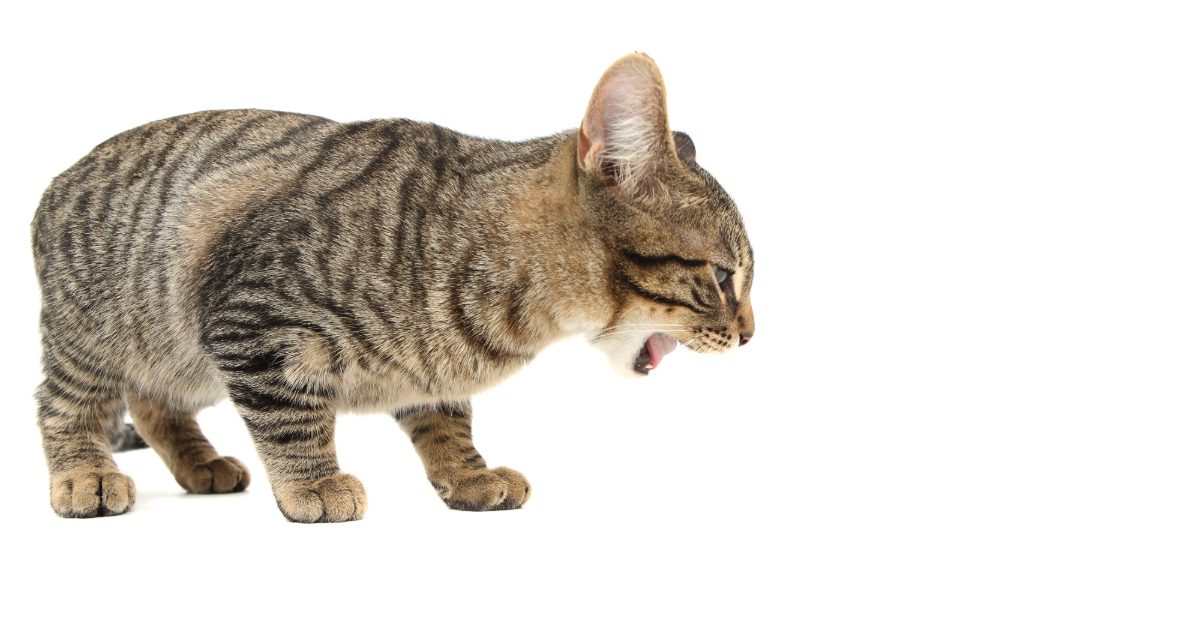
- Gagging, retching, or coughing
- Drooling more than usual
- Lethargy or unusual stillness
- Loss of appetite or refusal to drink water
- Abdominal pain, bloating, or a hunched posture
- Straining to defecate or producing no stool
It is important to note that a cat coughing repeatedly after playing with a small object may also be a sign that something has become lodged in the throat or airways. A cat coughing in this context is an urgent symptom that warrants immediate veterinary evaluation.
What Is a Gastrointestinal Obstruction in Cats?
When a cat swallows a foreign object, one of the most serious possible outcomes is a gastrointestinal obstruction. This occurs when the swallowed item becomes lodged in the esophagus, stomach, or intestines, blocking the normal passage of food and fluid through the digestive tract.
A partial obstruction may allow some material to pass but will still cause significant symptoms and discomfort. A complete obstruction is a medical emergency. Without prompt treatment, intestinal obstructions can lead to tissue death, perforation of the intestinal wall, and life-threatening infection within the abdominal cavity.
Can a Swallowed Foreign Object Pass on Its Own?
In some cases, small smooth objects may pass through a cat’s digestive system without causing a blockage. However, it is never safe to assume this will happen. Many objects that appear small or manageable can still cause injury or obstruction, and there is no reliable way to know without veterinary evaluation. Do not wait for the object to pass before seeking care.
My Cat Is Coughing After Swallowing Something — Is That an Emergency?
Yes. A cat coughing after potentially ingesting a foreign object should be evaluated by your veterinarian right away. There are two possible explanations, and both require urgent attention.
First, the object may have entered the airway rather than the esophagus, causing a respiratory obstruction. This is immediately life-threatening. Second, the object may have lodged in the upper digestive tract, triggering a cough reflex or causing irritation to the surrounding tissues. In either case, a cat coughing in this context is not something to monitor from home.
Persistent cat coughing that cannot be explained by known respiratory conditions should also be evaluated, as it can sometimes be a sign of an object that was swallowed days or weeks prior and is now causing chronic irritation or infection.
What Will the Vet Do If My Cat Swallowed a Foreign Object?
When you bring your cat to Humane Animal Medical & Surgical Hospital in Plano, TX, our veterinary team will perform a thorough physical examination and obtain a complete history of the incident. Diagnostic imaging, including X-rays, is typically used to locate the foreign object and assess whether a blockage or injury has occurred.
Treatment depends on where the object is and what type of object was swallowed:
- Objects in the stomach may sometimes be retrieved using endoscopy, a non-surgical procedure using a flexible camera
- Objects that have passed into the intestines typically require surgical removal
- Objects lodged in the esophagus may require a different approach depending on the object type and location
Our surgical team at Humane Animal Medical & Surgical Hospital is experienced in managing these emergencies and will develop a treatment plan specific to your cat’s situation.
Preventing Your Cat from Swallowing Foreign Objects
Once you have dealt with the immediate concern of a cat that swallowed a foreign object, taking steps to cat-proof your home can prevent future emergencies. Cats are resourceful and determined, so a proactive approach works better than reactive measures.
Practical steps to reduce the risk include:
- Storing string, ribbon, rubber bands, and hair ties in closed drawers or containers
- Choosing cat toys that are too large to be swallowed whole and checking them regularly for damage
- Keeping sewing supplies, including needles and thread, completely out of reach
- Supervising playtime with toys that have small detachable parts
- Discussing any compulsive chewing or eating behaviors with your veterinarian
Creating a safer environment for your cat takes only a few minutes but can prevent a serious, costly, and heartbreaking emergency.
Act Quickly: Your Cat’s Life May Depend on It
When a cat swallows a foreign object, every hour matters. The difference between a straightforward endoscopic retrieval and major abdominal surgery can come down to how quickly veterinary care is sought. If your cat is showing any symptoms of distress, vomiting repeatedly, coughing after playing with a small object, or has a known history of ingesting non-food items, contact Humane Animal Medical & Surgical Hospital in Plano, TX immediately.
Our team is here to provide compassionate, expert care when your cat needs it most. Do not wait to see if things improve on their own. Trust your instincts as a pet owner and reach out. Call Humane Animal Medical & Surgical Hospital at (972) 578-2553 for urgent care today.
Recent Posts
About Us
Small description of the practice goes here - maybe pull from the About Us page?